Paranormal Investigation: How Professionals Actually Do It (Step by Step)
What is paranormal investigation? Paranormal investigation is the documented, systematic examination of reported phenomena that fall outside conventional scientific explanation. A professional investigation follows five stages: case intake, environmental baseline, controlled evidence capture, analysis against natural explanations, and a written report. Its purpose is to find out what actually produced an experience, not to "catch a ghost".
By Rith Deb, core team member of the Indian Paranormal Society · 13+ years, 200+ locations investigated · Last updated: 2026-10-13
What paranormal investigation is, and isn't
A paranormal investigator is a person who uses documented, systematic methodology to examine reported phenomena that fall outside conventional scientific explanation. "Paranormal" means "beyond normal": phenomena that the current scientific framework cannot yet account for. It does not mean that ghosts or entities have been confirmed.
Paranormal investigation is not:
- TV ghost hunting, where the aim is dramatic footage
- spiritual remediation, exorcism or rituals
- debunking by default (the method requires real openness to whatever the evidence shows)
- content creation first. Documentation comes first, and content, if any, follows from it.
The Indian Paranormal Society, where Rith is a core team member, states the same boundary: "We do not claim to exorcise or eliminate paranormal entities. Our role is to investigate, document, and support individuals through education and awareness."
The five stages of a paranormal investigation
Rule zero: "Every investigation starts with one rule — prove it isn't paranormal first. If you can't eliminate the natural explanation, you don't have a case." (Rith Deb)
Stage 1: Case intake and pre-investigation research
Before anyone visits, take a detailed account from the person reporting:
- when the phenomena started, and what exactly happens
- how many people have experienced it, and whether they experience the same thing
- recent changes to the location (renovation, new appliances, new occupants)
- health changes in the household, such as headaches, fatigue or nausea. Several environmental causes (CO, mould, some EMF conditions) also have health effects.
- pet behaviour, which can be an early warning sign of CO
Then research the site: historical records, eyewitness accounts and a structural survey. Understanding the space on paper comes first.
Stage 2: Environmental baseline
An environmental baseline is the set of readings that describes a location's normal conditions before the investigation begins. Without it, every later reading is contaminated, because you cannot tell an anomaly from the building's ordinary behaviour.
Document across all accessible areas:
- EMF in every room, with every electrical source identified and mapped
- Temperature mapping
- Air quality, including carbon monoxide in residential cases
- Acoustics and infrasound
- Structural conditions and known interference sources
This step usually takes the first hour on site. It produces no dramatic footage, which is exactly why entertainment content skips it.
Stage 3: Controlled evidence capture
Capture audio, video, photographs and instrument data under controlled conditions:
- Fixed positions, not waving. Place meters at fixed measurement points. A meter waved through the air records every wiring run and appliance in the building, which is noise.
- At least two meters per fixed point. One meter cannot separate a real localised anomaly from instrument error. Two meters reading the same anomaly at the same time, from different angles, with no identified source, is data worth noting.
- Log everything with time, location and environmental context.
- Mark audio anomalies in-session with timestamps, so the review is targeted later.
Stage 4: Analysis against natural explanations
Every item is reviewed against the baseline and against known explanations:
- Compare an EMF spike with the baseline map.
- Compare an audio capture with the site's acoustic profile.
- Work through the natural-cause checklist: structural, acoustic, electromagnetic, psychological and human error.
What counts as an EMF anomaly: a reading elevated beyond the established baseline, in a spot with no known electromagnetic source, that repeats across multiple measurements. The number alone means nothing. What matters is the deviation from baseline.
Classifying EVP: EVP captures are commonly graded Class A, B or C. Class A is clearly intelligible without enhancement, agreed on by multiple listeners, and needs no processing. Never inflate a Class C capture into something it isn't.
Stage 5: The written report
Documentation is the core product of a paranormal investigation. Every case produces a written report covering what was reported, what was investigated, what was found, what was explained, and what remains unexplained. Inconclusive evidence is labelled inconclusive. Use the free template below.
The Indian Paranormal Society describes its own process in six stages: initial contact and briefing, pre-investigation assessment, on-site investigation, evidence analysis, client consultation, and follow-up support. It is the same logic, with the client debrief and aftercare split out as their own stages (IPS Investigations).
Paranormal investigation equipment
Equipment documents conditions. It does not detect spirits.
| Tool | What it actually measures | How professionals use it |
|---|---|---|
| EMF meter (e.g. TriField TF2; three-axis models such as the TriField 100XE for directional data) | Electromagnetic field strength in mG or µT | Baseline mapping, then fixed-point readings with two meters |
| CO detector | Carbon monoxide in parts per million (ppm) | Mandatory in residential cases, and run first |
| Audio recorder | Sound, including EVP candidates | Sessions with in-session timestamps; Class A/B/C review |
| Condenser microphone + spectrogram software | Low-frequency sound, including infrasound | Look for consistent energy around 15–25 Hz that varies between rooms |
| Thermal / infrared camera | Surface temperature | Mapping cold spots against drafts, plumbing and structure |
| Spirit box | AM/FM radio sweep | Exploratory only; use reproducible sweep settings |
| Motion sensors, REM pods, laser grids, K2 meters | Motion, field changes | Listed in IPS's equipment kit; use them as triggers to investigate, not as proof |
Avoid cheap novelty "ghost detector" meters. They are not calibrated for anything in particular and react to phones, bodies and passing cars.
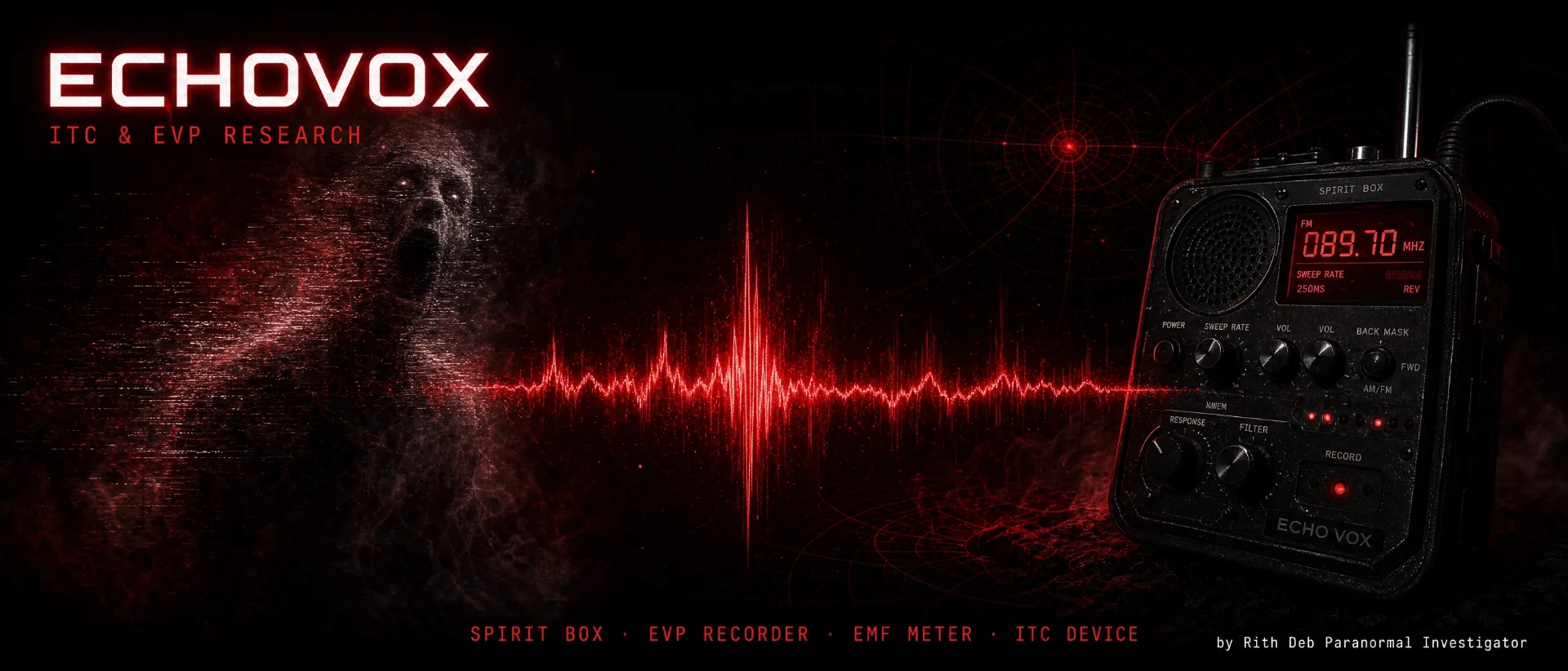
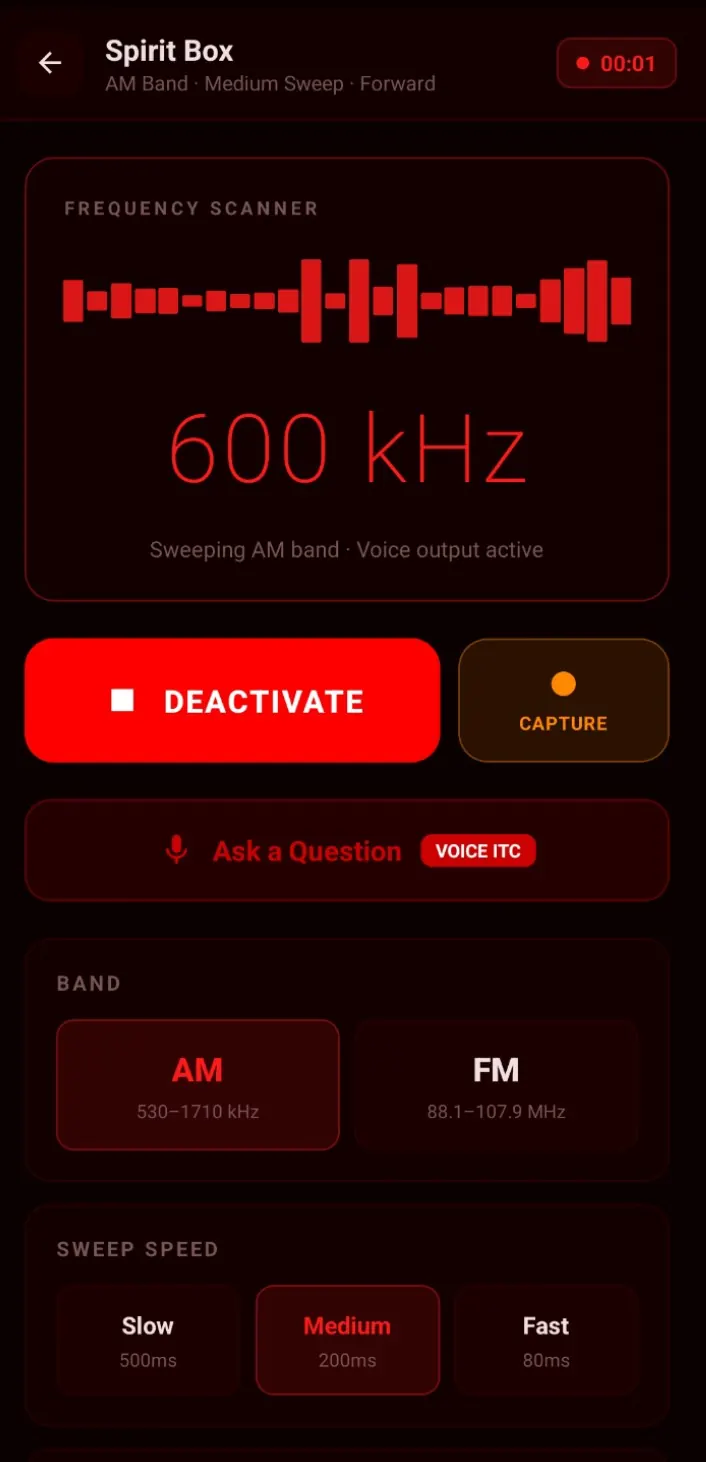
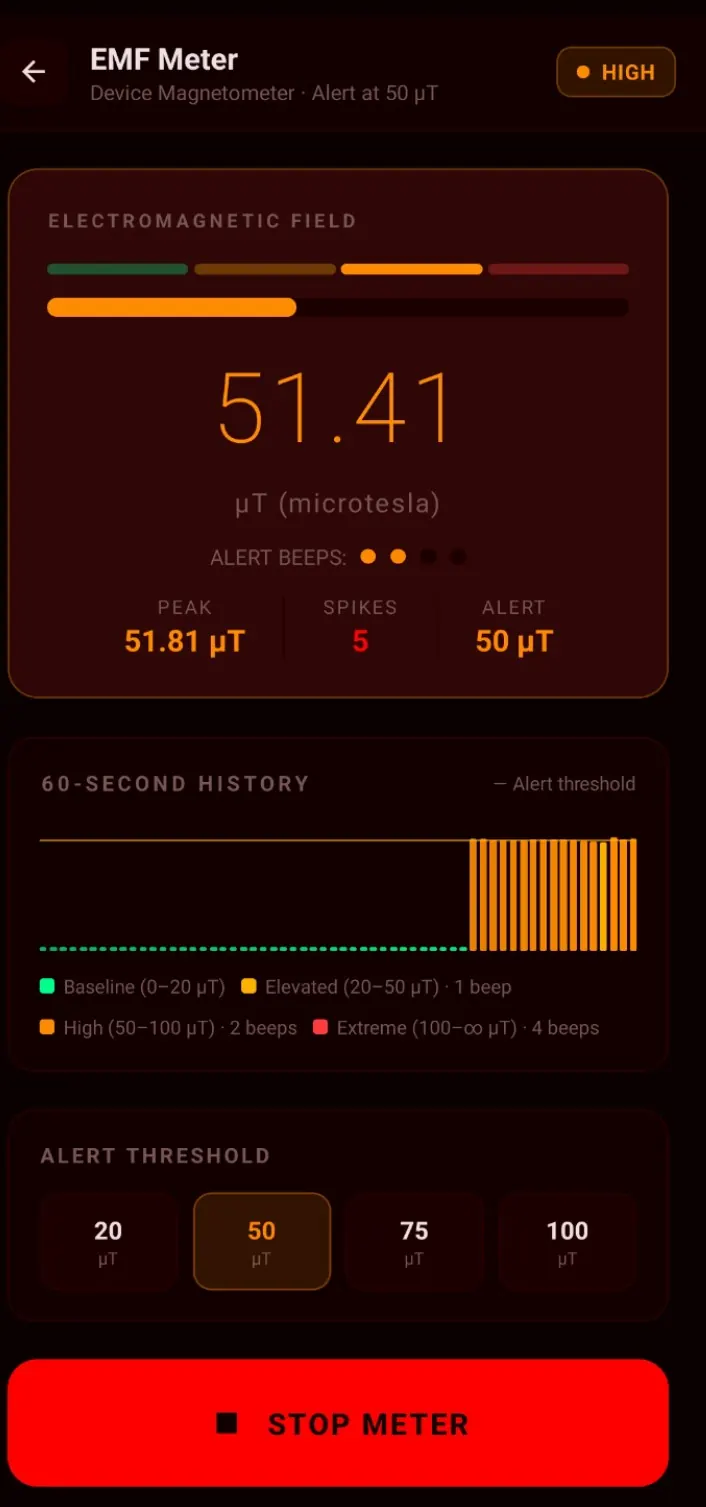
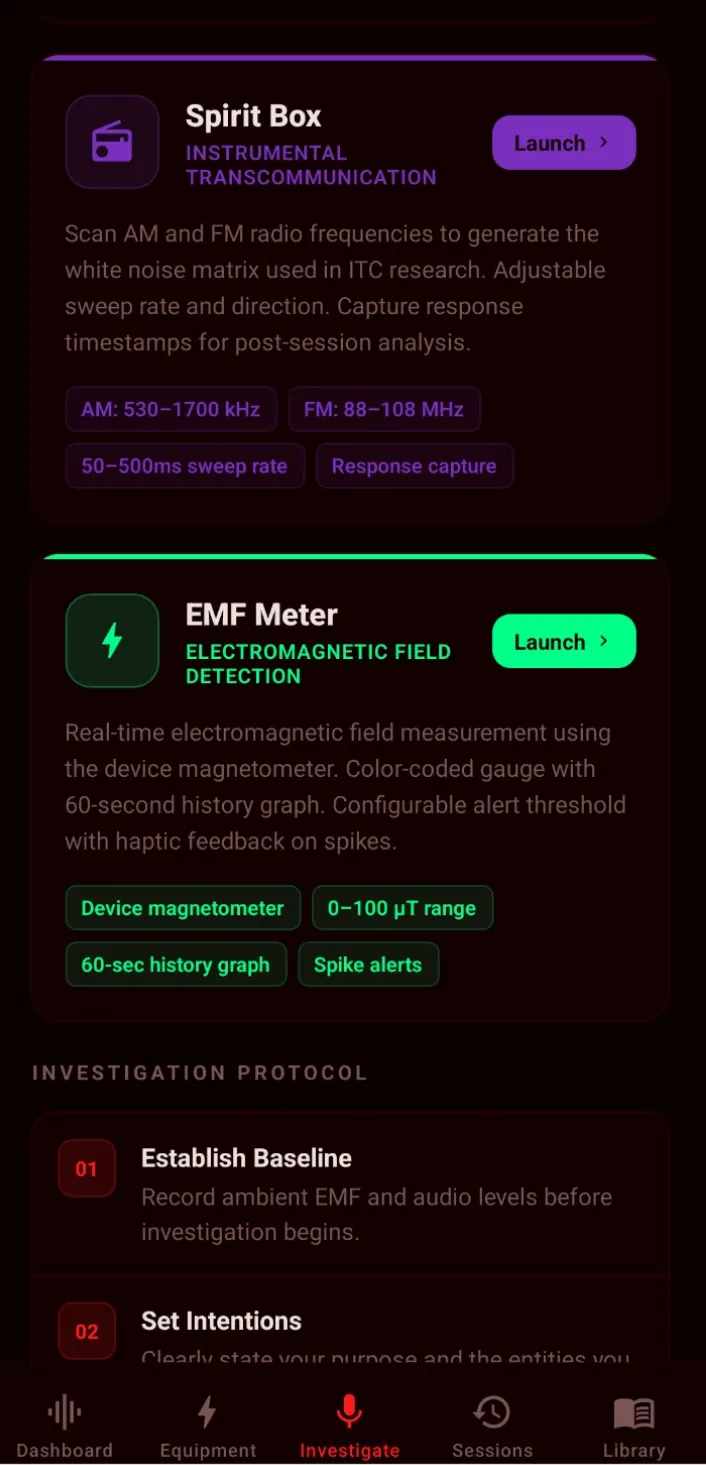
On your phone: Rith's free Android app ECHOVOX calibrates its EMF meter against the location's ambient baseline. It records EVP with in-session anomaly timestamps and captures up to 48 kHz, and its spirit box has a controllable sweep for reproducible sessions. Its Direct Voice Q&A feature is labelled exploratory, not evidentiary. How ECHOVOX works
Reading EMF numbers (typical indoor ranges, from Rith's field guide):
- 0.5–2.5 mG: normal background with ordinary wiring. Means nothing.
- 2–10 mG within half a metre of appliances: still normal.
- 5–20 mG or more near old wiring, junction boxes or breaker panels: elevated, but with an identified source.
Full guide: How to use an EMF meter.
Natural explanations professionals rule out first
Carbon monoxide
Carbon monoxide (CO) is a colourless, odourless gas whose low-level symptoms closely mirror "haunted house" reports. Those symptoms include headaches, dizziness, visual disturbances at the edge of vision, sounds that are hard to locate, dread and a sense of presence. A widely cited case was documented by physician William Wilmer in the American Journal of Ophthalmology in 1921. A family's "haunting" turned out to be a faulty furnace, and the phenomena stopped once it was repaired.
CO readings to know:
- 0–9 ppm: normal
- 10–35 ppm: low-level chronic exposure
- 35–70 ppm: symptoms in healthy adults over hours
- 70+ ppm: dangerous
Safety rule: if a residential investigation finds CO above 10 ppm from an unidentified source, the investigation stops. The family opens up the building, calls a gas technician, and does not return until the source is repaired and re-tested. Read the CO guide
Infrasound
Infrasound is sound below 20 Hz, below the threshold of human hearing. Around 18–19 Hz it is associated with unease, a sense of presence, movement at the edge of vision and pressure in the chest. In 1998, Coventry University engineer Vic Tandy documented an 18.98 Hz standing wave produced by a fan in a laboratory where staff reported such experiences. When the fan was turned off, the experiences stopped. To test for it, use a condenser microphone with flat response below 20 Hz and spectrogram software, then switch mechanical systems off one by one. Read the infrasound guide
Electromagnetic fields
High-EMF spots near wiring, appliances and breaker panels produce spikes that untrained investigators mistake for activity. Some researchers also propose that high-EMF environments cause physical symptoms that people interpret as paranormal. Both hypotheses are unconfirmed, which is why the EMF meter is a documentation tool.
Acoustics, structure and psychology
Settling buildings, plumbing, drafts, sound travelling through shared walls, sleep states, stress and the team's own confirmation bias all need to be ruled out.
Ethics of paranormal investigation
- Client welfare comes first. The people who call an investigator are frightened, so stay calm and professional, and refer them to a doctor or technician when health or safety is at stake.
- No rituals, no remedies, no "removal".
- Respect property, privacy and beliefs. IPS's values include respecting "both the client and the client's property".
- Honesty over drama. Never stage, exaggerate or sensationalise ambiguous evidence for content.
- Respect other groups. Cooperation, not rivalry, is part of IPS's stated values.
- Respect access rules. Government restrictions apply at some sites. For example, IPS notes that night-time access to Bhangarh Fort is restricted.
Paranormal investigation in India: the context
India adds a dense cultural layer. By the time an investigator arrives, a family has often already interpreted events through religious belief and folklore, and has sometimes paid for rituals. A competent investigator respects those beliefs and still gives an evidence-based assessment.
Indian homes also have specific natural-cause risks: LPG stoves in poorly ventilated kitchens, unserviced gas geysers, generators run in enclosed spaces during power cuts, and traditional chulhas, all of which are CO sources.
Examples from IPS case files. The Indian Paranormal Society publishes case files for well-known Indian locations, including Bhangarh Fort and Kuldhara Village (Rajasthan), Mukesh Mill (Mumbai), Tunnel 33 (Shimla) and Lambi Dehar Mines (Uttarakhand). Each lists the reported activity, IPS's findings and a status (IPS Case Files). They are worth reading to see how a team documents reported activity at heritage and industrial sites. Read IPS's findings in its own words.
Free download: paranormal case-report template
Copy this structure for every case.
PARANORMAL INVESTIGATION CASE REPORT
Case ID: ______  Date(s): ______  Location (general, confidential): ______
Lead investigator: ______  Team: ______  Client consent on file: Y / N

1. CASE INTAKE
   Reported phenomena (client's words): ______
   Start date / frequency / time of day: ______
   Witnesses (number, same experience?): ______
   Recent changes to the location: ______
   Household health changes (headache, fatigue, nausea, sleep): ______
   Pet behaviour: ______
   Prior rituals or "remedies" already tried: ______

2. PRE-INVESTIGATION RESEARCH
   Site history / records: ______
   Structure, wiring, gas appliances, ventilation: ______

3. ENVIRONMENTAL BASELINE (per room)
   Room | EMF (mG) + identified sources | Temp | CO (ppm) | Acoustic / infrasound notes
   ______________________________________________________________

4. EVIDENCE LOG
   Time | Location | Instrument/meter ID | Reading or capture | Conditions | Logged by
   ______________________________________________________________

5. ANALYSIS
   For each item: baseline comparison | natural causes checked
   (structural / acoustic / electromagnetic / CO / psychological / human error) | result
   EVP classification (A / B / C) and number of independent listeners: ______

6. FINDINGS
   Explained (cause + evidence): ______
   Inconclusive (labelled as such): ______
   Unexplained after elimination: ______

7. CLIENT DEBRIEF & SAFETY ACTIONS
   Advice given (e.g. gas technician, doctor, ventilation): ______
Follow-up date: ______Learn paranormal investigation properly
- New to the field? Read How to Become a Paranormal Investigator in India.
- Structured training: the Rith Deb Paranormal Academy's paranormal investigation course in India teaches this method online in Hindi and English. It is Rith's own programme, taught following IPS methodology, and not an IPS course. Fees will be announced at the Academy launch, with Founders' pricing for early members (waitlist).
- What the four courses cover: Paranormal Investigation Course in India: Complete Guide.
FAQ
What is paranormal investigation?
Paranormal investigation is the documented, systematic examination of reported phenomena that fall outside conventional scientific explanation. It runs through case intake, environmental baseline, controlled evidence capture, analysis against natural causes and a written report.
Is paranormal investigation scientific?
It can be, when it follows a method: establish a baseline, use calibrated instruments, rule out natural causes such as CO, infrasound and EMF, and report honestly, including when the result is inconclusive. Investigation without a baseline or written report is entertainment, not science.
What equipment do I need for a paranormal investigation?
At minimum, two EMF meters used at fixed points, a carbon monoxide detector, an audio recorder and a case log. Add a thermal camera and a low-frequency microphone for infrasound as you progress. Avoid cheap novelty ghost detectors.
How long does a paranormal investigation take?
It depends on the size of the site and the case. Baseline mapping alone usually takes about the first hour on site, before any evidence collection begins, and analysis and the written report follow after the visit.
Train with Rith Deb
Get on the waitlist for the next intake of the Rith Deb Paranormal Academy.
JOIN THE WAITLIST