How I Actually Use an EMF Meter — What the YouTube Videos Get Wrong
EMF meters measure electromagnetic field strength — not ghosts. Used correctly, they document anomalies against an established baseline. Used the way YouTube shows, they produce noise. Here is the right methodology, the common misuses, and which meters are actually worth buying in India.
The Most Misused Tool in the Field
The EMF meter is the most recognisable piece of equipment in paranormal investigation.
It is also the most misused.
If your entire understanding of how to use an EMF meter comes from YouTube ghost-hunting content, I want to be direct with you: what you have watched is mostly entertainment, not methodology. The way EMF meters are used on camera — waved around dark rooms, beeping dramatically at walls — is the opposite of how they function as investigation tools.
Here is how I actually use one. After 13 years and 200+ investigations.
What an EMF Meter Actually Measures
EMF stands for electromagnetic field. It is a field produced by electrically charged objects. Everything that runs on electricity — wiring, appliances, power lines, circuit breakers, motors — produces an electromagnetic field.
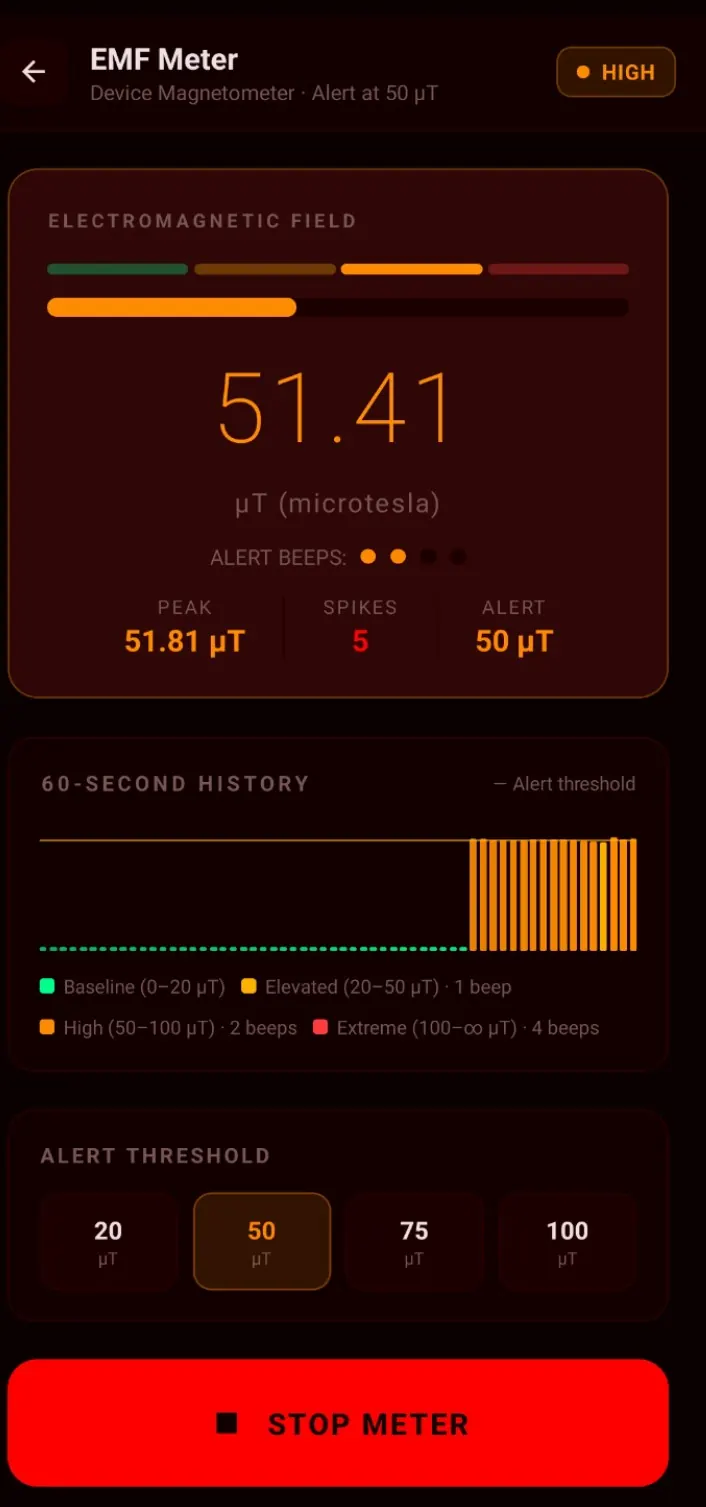
An EMF meter measures the strength of this field in the area around the device. It gives you a reading in milligauss (mG) or microtesla (µT) depending on the meter.
That is all it does. It measures electromagnetic field strength. It does not detect ghosts. It does not confirm paranormal activity. It does not communicate with entities.
The reason EMF meters are used in paranormal investigation is a hypothesis — not a confirmed fact — that paranormal activity may be associated with anomalous electromagnetic readings. Some researchers have proposed that entities, if they exist, may interact with or generate electromagnetic fields. Others propose the opposite: that high EMF environments cause the neurological and physiological symptoms that people interpret as paranormal experiences.
Both hypotheses have some research support. Neither is confirmed. Which means the EMF meter's job in investigation is documentation, not detection.
The Baseline Problem — Why 90% of Ghost Hunting Content Is Wrong
Here is the thing nobody on YouTube tells you.
Before you can say that an EMF reading is anomalous, you need to know what the baseline is for that location.
Every location has an electromagnetic baseline. A house with old wiring has a different baseline than a new construction. A location near power lines has a different baseline than a rural building. A basement near electrical infrastructure has a different baseline than the floor above it.
When you watch a ghost-hunting video and someone waves an EMF meter around a dark room and it spikes, there are two possible explanations: something anomalous is happening, or that part of the room is near a wiring run, an appliance, a junction box, or any other known electromagnetic source.
Without a baseline map of the location — documenting EMF readings across the entire space before any investigation begins, with all electrical sources identified and mapped — you cannot tell the difference.
This is the step that gets skipped in entertainment content because it takes an hour and produces no dramatic footage. But it is the most important step in using an EMF meter correctly.
My standard protocol: arrive at any location, map every room with an EMF meter before anything else happens, note every reading and every identified source, build a baseline document. Only then does subsequent EMF data mean anything.
How to Read EMF Data Correctly
Standard background EMF in a typical indoor environment with normal wiring: 0.5–2.5 mG. This is normal. It means nothing.
Near electrical appliances (fridges, microwaves, televisions): can read 2–10 mG within half a metre. Still normal. Still means nothing for investigation purposes.
Near old wiring, junction boxes, circuit breaker panels: can read 5–20 mG or higher. This is elevated but has an identified source.
What matters in investigation is: a reading that is elevated beyond the established baseline, in a location where no known electromagnetic source has been identified, that repeats consistently across multiple measurement attempts.
That is what you are looking for. Not the number itself — the deviation from baseline in a location where the deviation cannot be explained.
The Three Common Misuses I See Constantly
Misuse 1: Using a single meter in motion. Waving an EMF meter through the air as you walk gives you a continuous stream of readings that reflect every wiring run, every electrical device, every piece of infrastructure in the building. It is noise. You cannot interpret it because you have no fixed reference point. Proper use: place meters at fixed positions. Take readings at specific points. Document each reading with its precise location in the building relative to your baseline map.
Misuse 2: Treating any spike as confirmation. A spike on an EMF meter means the electromagnetic field in that location is higher than the surrounding area. That is a fact. It does not mean paranormal activity is present. It means something is producing more electromagnetic field than the surroundings. Your job is to find out what.
Misuse 3: Using only one meter. Single-meter investigations cannot distinguish between a genuine localised anomaly and instrument error. I use a minimum of two meters at every fixed measurement point, and I triangulate readings from multiple positions. If both meters read the same anomaly at the same time, from different angles, with no identified source: that is data worth noting.
Which EMF Meters Are Worth Buying in India
Three categories: entry level, mid-range, and professional.
Entry level — TriField TF2 (₹8,000–12,000 imported). The TF2 is the standard beginner recommendation for a reason. It measures AC electric fields, AC magnetic fields, and radio/microwave frequencies. It has a useful audio indicator and a peak hold function. It does not have logging capability, which is a limitation for serious investigation documentation. But for someone starting out who wants a reliable, well-calibrated meter: this is the one.
Entry level India alternative — Latnex AF-5000. More readily available in India through electronics importers. Comparable sensitivity to the TF2. Less intuitive interface. Functional for baseline work and spot readings.
Mid-range — TriField 100XE. Older model but still highly regarded for its three-axis measurement (simultaneous measurement on all axes without rotating the meter). For serious investigation work where you need precise directional data, three-axis measurement is significantly more useful than single-axis meters.
What to avoid: the cheap "ghost detector" meters sold on Amazon India for ₹500–1,500. These are consumer toys calibrated for nothing in particular. They respond to essentially anything — your phone, your body's own bioelectric field, a passing car. The readings they produce are meaningless for investigation purposes and will either give you false positives constantly or give you nothing. Do not investigate with them.
One honest caveat: no EMF meter currently available to consumer investigators is designed for paranormal investigation. They are all repurposed from electrical engineering and occupational health contexts — they measure EMF because electricians and building inspectors need to know where high EMF is coming from. The paranormal investigation community has adopted them because they are the best available proxy tool. This does not make them definitive. It makes them useful, when used correctly.
EMF and the Human Body — Why This Matters for Investigators
There is a second reason to understand EMF correctly that goes beyond investigation: your own exposure.
High EMF environments — which you may be standing in for extended periods during night investigations in old buildings — have associated health effects. At levels above approximately 10–12 mG with sustained exposure, some research links EMF to sleep disruption, headache, and the specific set of perceptual disturbances (unease, sense of presence, mild visual disturbances) that closely mirror what people describe in "haunted" locations.
First implication: if you are experiencing sensations during an investigation and your EMF meter shows elevated readings in your location, you need to factor in the possibility that the elevated EMF is directly causing your sensations. Document it. Do not dismiss it. But do not assume the EMF is caused by something paranormal when your body is in it — your body is reacting to electromagnetic field, which has identified physics behind it.
Second implication: limit your exposure time in high-EMF zones during investigation. This is basic occupational health practice. Document the anomaly, get what data you need, and move.
The Right Mental Model for EMF Investigation
Think of the EMF meter the way a doctor thinks of a thermometer.
A temperature reading tells you something is elevated. It does not tell you why. It does not tell you what is causing the fever. It tells you that investigation is warranted and gives you a baseline to measure change against.
An EMF reading tells you the electromagnetic environment at that point is higher than normal. It does not tell you why. It does not confirm or deny paranormal activity. It tells you that further investigation of that specific zone is warranted, and it gives you a documented data point.
That is the tool. Used that way, it is valuable. Used as a ghost-detection device that beeps when spirits are present: it is theatre.
Equipment is only as good as the methodology behind it. If you want to understand the full investigation protocol — how EMF fits into a complete case, alongside thermal imaging, audio recording, environmental assessment, and documentation — that is what my courses cover in detail.
FAQ
Does an EMF meter detect ghosts?
No. An EMF meter measures electromagnetic field strength. Its use in paranormal investigation is based on a hypothesis that anomalous EMF may correlate with reported activity. It is a documentation tool, not a detection tool.
What EMF reading is considered paranormal?
There is no such number. What matters is a reading that deviates from the established baseline for that specific location, in an area with no identified electromagnetic source, that repeats across multiple measurements.
Which EMF meter should a beginner in India buy?
The TriField TF2 is the standard recommendation. The Latnex AF-5000 is a more available India alternative. Avoid the ₹500–1,500 "ghost detector" toys sold on Amazon — they are not calibrated for serious investigation.
Why do YouTube ghost hunters wave their EMF meters around?
Because it makes dramatic footage. Methodologically it is wrong — it produces a continuous stream of noise reflecting every wiring run and appliance in the building, with no fixed reference point to interpret it against.
Train with Rith Deb
Get on the waitlist for the next intake of the Rith Deb Paranormal Academy.
JOIN THE WAITLIST