Paranormal Investigation Equipment: A Beginner's Kit Overview
Paranormal investigation equipment for a beginner is simple: a notebook, a torch, an audio recorder, a camera, an EMF meter and a thermometer. None of these tools detects ghosts. They measure the environment, so you can find and rule out natural causes such as wiring, drafts, dust and noise, and keep an honest record of what happened.
By Rith Deb, core team member of the Indian Paranormal Society · 13+ years, 200+ investigations · Last updated: 29 October 2026
Note: rithdeb.com is Rith Deb's personal site. It is not the Indian Paranormal Society website, and nothing on it grants IPS or G.R.I.P membership. The Indian Paranormal Society's own information is at indianparanormalsociety.in and on the IPS blog.
Why equipment matters in paranormal investigation
In paranormal investigation, equipment has one job: to measure what is really there. Rith Deb learned this under Gaurav Tiwari, who directly mentored him after Rith joined the Indian Paranormal Society in 2013, and he still follows IPS methodology in the field. In that method, tools support the baseline and the natural-cause checks described in our step-by-step guide to a paranormal investigation. Expensive gear is not needed. Knowing each tool's limits is.
Tools don't detect ghosts
This is the most important thing a beginner can learn. No meter, camera or recorder has been shown to detect spirits. A tool reports light, sound, temperature or an electromagnetic field. What that reading means is decided by you, and the honest first question is always: what ordinary thing could cause this? Treat every unusual reading as a lead to check, never as proof. This evidence-first habit is also what separates an investigator from a casual ghost hunter, as explained in Paranormal Investigator vs Ghost Hunter.
The beginner's kit, tool by tool
1. Notebook and pen
What it does: records the time, place within the site, who was present, the weather, and every reading or event as it happens.
What it can't prove: anything on its own. A note is only as good as the honesty and timing of the person writing it.
How to log results: write the time against every entry, note who was in the room, and record ordinary sounds (traffic, pipes, neighbours) as well as odd ones. Notes written afterwards from memory should be marked as such.
2. Torch
What it does: lets you move safely and inspect corners, ceilings, wiring and floors.
What it can't prove: nothing paranormal. Its value is safety and inspection.
Common false positives: a torch beam reflecting off glass, mirrors or shiny surfaces can show up in photos and video as strange lights. Note where your light was pointing.
How to log results: note when torches were switched on or off, so light changes in recordings can be matched to them.
3. Audio recorder
What it does: records sound so it can be reviewed later, including sounds you missed in the moment.
What it can't prove: that a sound has a paranormal source. People naturally hear words and voices in random noise, such as fans or air conditioners. This is called auditory pareidolia, and it is the usual explanation for recorded "voices".
Common false positives: team members whispering or moving, appliances, plumbing, traffic and animals.
How to log results: say the time and any known noise aloud on the recording ("door closed, 10:42"), keep the original unedited file, and have someone who did not hear the moment review it before you describe it.
4. Camera
What it does: documents the site, the layout and the conditions, and records the scene at fixed points for later comparison.
What it can't prove: that a light or shape in a photo is a spirit.
Common false positives: the round "orbs" in flash photos are usually dust, moisture droplets or tiny insects close to the lens, lit by the flash while out of focus. Reflections off glass, mirrors and metal can also create orb-like spots and flares inside the lens.
How to log results: keep the original files with their timestamps, note whether the flash was on, and take a second photo from the same spot straight away. An orb that does not repeat is almost always a particle.
5. EMF meter (basics only)
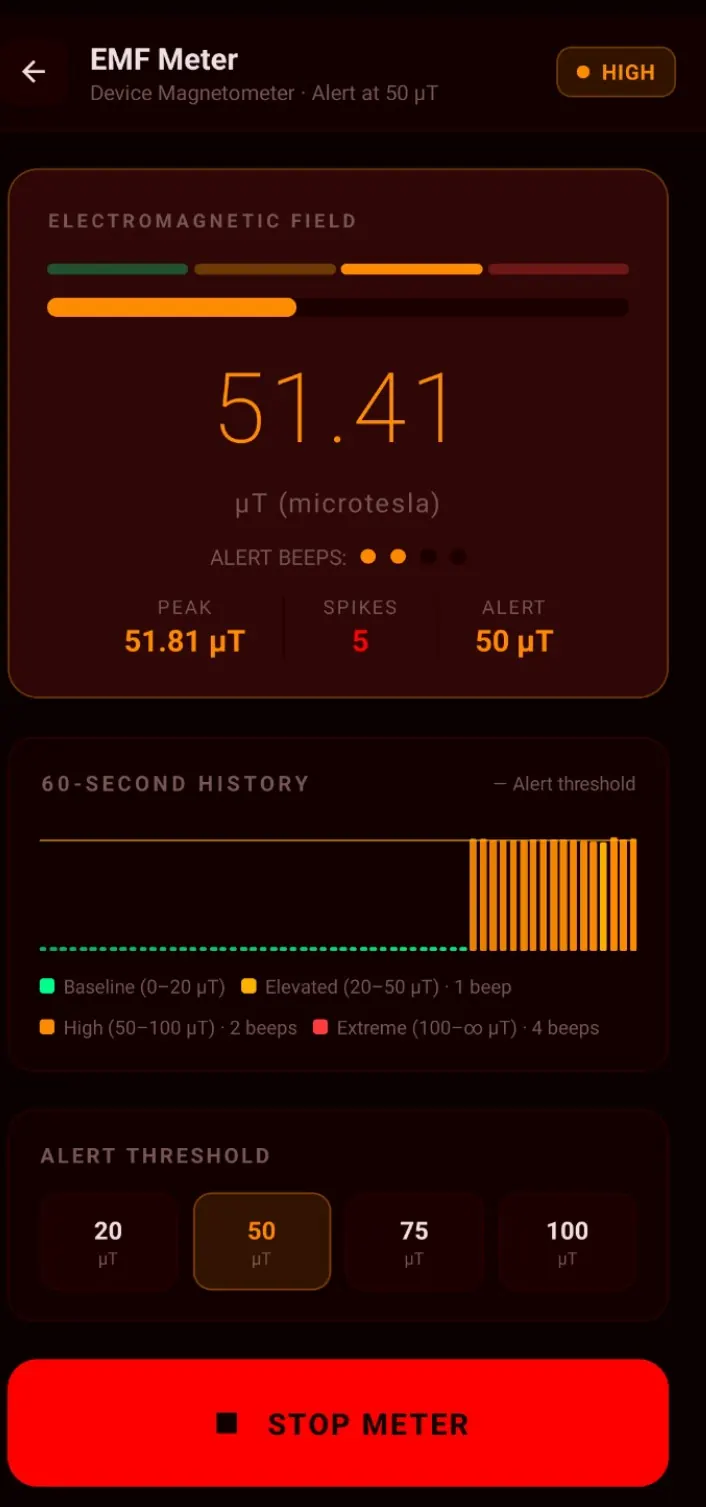
What it does: measures electromagnetic fields.
What it can't prove: the presence of a spirit. Everyday sources such as household wiring, electrical appliances and nearby power lines produce these fields all the time.
Common false positives: wiring inside walls, appliances, chargers, phones and the meter being moved quickly near any of them.
How to log results: take a baseline reading in each room before the investigation, mark where wiring and appliances are, and record any change with its time and location. A spike near a socket points to the socket. For step-by-step EMF readings, baselines and common misuses, read how to use an EMF meter.
6. Thermometer
What it does: measures temperature, so "cold spots" can be checked.
What it can't prove: that a cold spot is paranormal. Drafts, windows, vents and building materials are the first things to check.
Common false positives: a non-contact infrared thermometer reads the temperature of a surface, not of the air, so it cannot measure a cold spot in the air itself. Shiny or reflective surfaces, such as metal, can also give it wrong readings. For air temperature, use a thermometer that measures the air directly.
How to log results: record a baseline for each room, note what kind of thermometer you used and what you pointed it at, and recheck any change from the same position.
Safety and ethics
- Permission first. Only investigate with the owner's or occupant's consent. Never trespass or enter restricted or unsafe structures.
- Never alone. Work in a team, and tell someone outside where you are and when you expect to be back.
- Watch the air. Carbon monoxide is colourless and has no smell, and it can cause headaches, dizziness, tiredness and confusion. If people in a building report these symptoms, a fuel-burning appliance should be checked by a professional before anything else is considered.
- Respect the people involved. Families who report activity are often frightened. Protect their privacy, do not feed their fear, and explain natural findings calmly.
- Be honest in the report. "Natural cause found" is a good result.
Where to go from here
Equipment is the easy part. Method, honesty and safety take longer to learn. For the full path, read How to Become a Paranormal Investigator in India. If you want structured training in the method, see the paranormal investigation course page. You can also read more about Rith on the About page or read more about Rith Deb's work as a paranormal investigator in India.
Frequently asked questions
What equipment do I need to start paranormal investigation?
A beginner needs a notebook, a torch, an audio recorder, a camera, an EMF meter and a thermometer. Expensive gear is not needed. What matters is knowing what each tool measures and how it can give false readings.
Can an EMF meter detect ghosts?
No. An EMF meter measures electromagnetic fields, and everyday sources such as household wiring, electrical appliances and power lines produce them. In an investigation it is used to find those natural sources. For how to use one properly, see how to use an EMF meter.
What are orbs in ghost photos?
Orbs in flash photos are usually dust, moisture droplets or tiny insects close to the lens, lit by the flash while out of focus. Reflections off glass, mirrors and metal can also create orb-like spots.
Can an infrared thermometer find a cold spot?
Not in the air. A non-contact infrared thermometer reads the temperature of a surface, not of the air. To check a cold spot, use a thermometer that measures the air directly and look for drafts first.
Why do audio recordings seem to contain voices?
People naturally hear words and voices in random noise, which is called auditory pareidolia. That is why investigators keep the original file, log known noises aloud and have someone else review a recording.
Train with Rith Deb
Get on the waitlist for the next intake of the Rith Deb Paranormal Academy.
JOIN THE WAITLIST